


Spotlight: Mansun Wang – reimagining measurement protocols for 2D materials
Critically evaluating existing methods and developing new protocols that enhance accuracy, repeatability and confidence in fundamental material parameters.
Mansun Wang, a Higher Research Scientist at National Physical laboratory (NPL), won the poster award for Fundamentals at Graphene Week 2025 in Vicenza, Italy. She is working on advancing measurement science for 2D materials to provide quantitative, traceable data on surface properties, interface behaviour and electronic structure so that researchers and industrial partners can compare results across different laboratories and measurement tools. She shared some insights on her work and goals with the Graphene Flagship.
How did you first start working with graphene and 2D materials?
I was first introduced to graphene and 2D materials (2DM) when I started my PhD at the University of Manchester in 2020, where I worked on Raman spectroscopy applied to graphene and other 2D systems. This became my entry point into the field, and I continued exploring 2D materials while expanding my experience with additional surface- and structure-sensitive characterisation techniques.
Why are you excited to work on graphene and 2DM?
Graphene and 2D materials provide a remarkable scientific playground, where atomic-scale effects can be directly observed in electronic and surface behaviour. I’m excited to work in this field because it evolves rapidly, continually raises new fundamental questions and holds real potential to influence future technologies that depend on ultrathin, stable and highly tuneable material systems.

Mansun Wang is a Higher Research Scientist at the National Physical laboratory (NPL).
Who has been the biggest influence or mentor in your career so far?
My PhD supervisors, Prof. Cinzia Casiraghi and Dr. Andrew Pollard, were my first mentors and gave me strong scientific foundations and passion for 2D materials. Later, at the National Physical Laboratory (NPL), colleagues within the Surface Technology group, and particularly my line manager Dr. Keith Paton, guided me in advanced surface-sensitive characterisation and working with industrial research environments. Their support has been instrumental in shaping my scientific growth.
How did you first become interested in your current research project?
My interest in this project started from a practical challenge: many measurements of 2D materials yield valuable qualitative insights, but there is a need for metrologically sound, traceable and reproducible techniques that can be reliably compared across labs and industries. This led me to work on establishing robust characterisation methodologies that quantify key properties of 2D materials. It’s a transition from simply using tools to improving how we use and validate them.
What’s your research focus? What is your current research goal?
I focus on advancing measurement science for 2D materials, particularly techniques that can provide quantitative, traceable data on surface properties, interface behaviour and electronic structure. My current goal is to improve and standardise these measurements so that researchers and industrial partners can compare results across different laboratories and measurement tools. This involves critically evaluating existing methods and developing new protocols that enhance accuracy, repeatability and confidence in fundamental material parameters.
It’s rewarding to work on the fundamentals of how we measure materials and to contribute to making characterisation more robust and trustworthy for the wider community."
National Physical laboratory
In what way can graphene and other 2DM improve this area?
Graphene offers a highly stable and conductive surface that is ideal for quantitative electronic and surface measurements. Many other 2D materials, including TMD semiconductors and layered dielectrics, form atomically clean van der Waals interfaces that can be studied without the lattice mismatch issues seen in conventional thin-film systems. This makes 2D stacks uniquely suitable for interface-dominated measurement science, helping us extract reliable material parameters and understand interfacial electronic behaviour in a reproducible and comparable way.
Why do you feel your research is important, and what benefits could it bring to society?
2D materials are being explored for a vast range of future technologies, but their industrial adoption depends on our ability to measure key surface and interface properties in a quantitative, traceable and reproducible manner. By improving the rigor and reliability of characterisation techniques, this work helps researchers and companies benchmark material performance with greater confidence. In the long term, this supports progress in electronics, sensors, coatings and advanced materials where 2D systems are expected to play a major role.
As an early career researcher, where do you see your field going?
I see the field shifting from proof-of-concept studies toward validated measurement protocols, traceable surface analysis and international standards for 2D materials. Future advances will likely focus on making characterisation more quantitative and comparable across laboratories and industries, especially for work function, defects, energy levels and interface behaviour. This will be essential for turning graphene and 2D research into a mature, reliable materials science discipline.
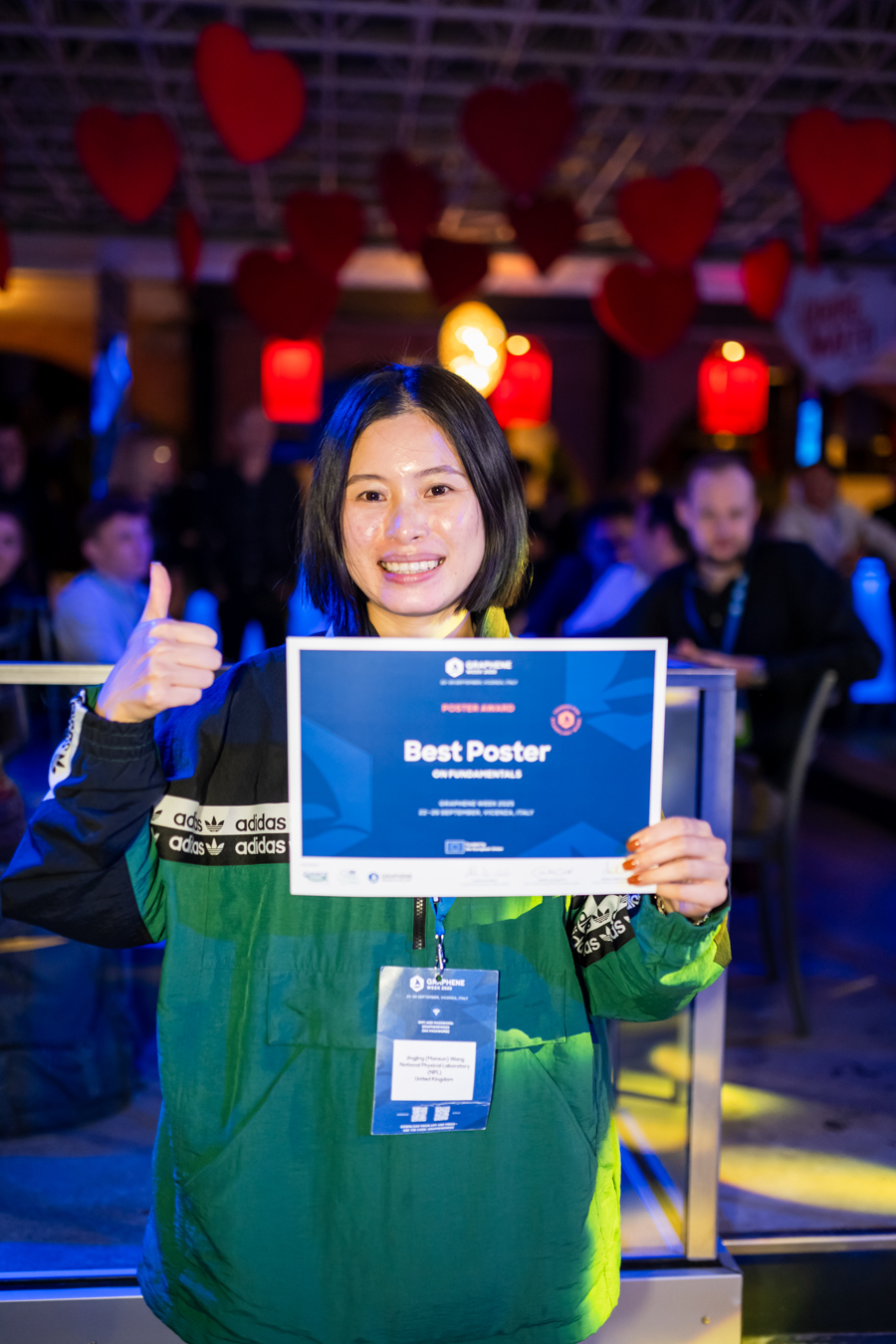
Mansun Wang won the poster award for Fundamentals at Graphene Week 2025 in Vicenza, Italy.
What do you enjoy the most in your career path?
I enjoy the process of refining measurement techniques and extracting meaningful physical and chemical insight from 2D material surfaces and interfaces. It’s rewarding to work on the fundamentals of how we measure materials, rather than only the materials themselves, and to contribute to making characterisation more robust and trustworthy for the wider community.
Do you have a favourite anecdote or moment from your research journey?
A memorable moment for me was during a late-night lab session when a measurement I had repeated many times finally produced a clean and interpretable spectrum. There was nothing extraordinary about the result itself, but that small breakthrough reminded me how progress in 2D materials often comes from persistence, refining experimental conditions and learning to distinguish real signals from artefacts. It wasn’t a dramatic discovery, just a quiet but satisfying reminder of why careful measurement matters.
What is the most challenging part of your current work?
The main challenge is improving measurement reliability for properties that are extremely sensitive to surface quality, environmental exposure and buried interfaces. Working toward traceability and reproducibility means critically evaluating methods, reducing uncertainty, and ensuring meaningful comparisons between different tools and datasets, work that is as demanding as it is essential for the field.
Progress in 2D materials often comes from persistence, refining experimental conditions and learning to distinguish real signals from artefacts."
National Physical laboratory
If you could work on any dream project involving 2D materials, what would it be?
A dream direction would be to contribute to establishing widely adopted reference standards and measurement protocols for large area 2D material interfaces, enabling labs and industries to extract and compare surface electronic properties with true metrological confidence.
What are your plans for the future?
I plan to keep working on advancing surface and interface characterisation of 2D materials, contributing to better measurement frameworks, uncertainty evaluation and cross-lab comparability, while collaborating with both academic and industrial partners interested in reliable 2D material benchmarking.
Tell us about your experience at Graphene Week 2025. How was this event for you?
Graphene Week 2025 was a valuable and energising event. It brought together experts across many areas of 2D research and offered a strong sense of where the community is heading. For me, the most important aspect was seeing the growing emphasis on interfaces, data reliability, and reproducible characterisation, and having the opportunity to connect with researchers who share the same measurement-driven mindset.
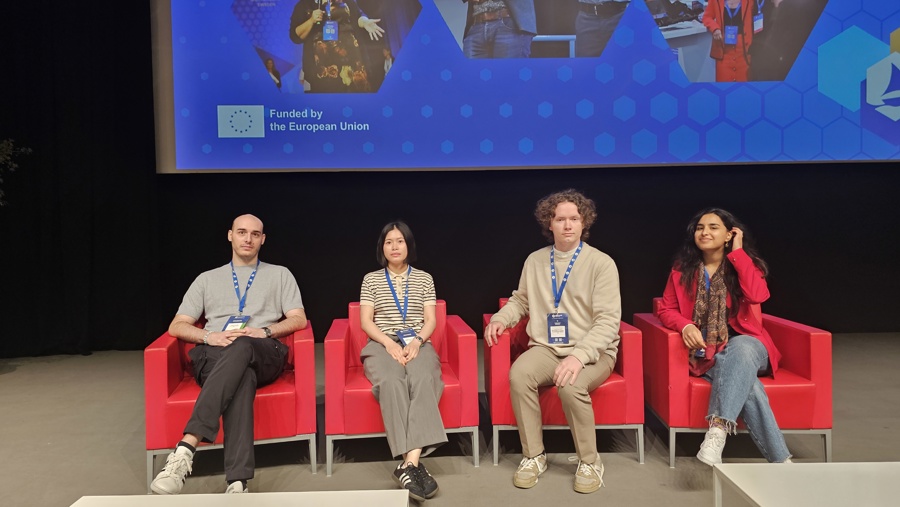
The Graphene Week 2025 poster winners
How did you feel about winning the Graphene Week Poster Award?
Winning the Poster Award was an honour and a great moment of encouragement. It felt rewarding to have my work recognised by a community that I admire, and it strengthened my motivation to continue contributing high-quality, rigorous research in 2D material characterisation.
What else would you like people to know about your work?
Graphene and 2D materials are a field full of potential, but what excites me the most now is helping the community move toward more reliable, quantitative and comparable measurements. I believe that improving how we characterise 2D surfaces and interfaces will be the key to the field’s next stage of scientific and technological maturity.
Winning the Poster Award was an honour and a great moment of encouragement. It felt rewarding to have my work recognised by a community that I admire."
National Physical laboratory
Graphene Week 2026
The 21st edition of Graphene Week will be held in Porto, Portugal, 21-25 September 2026! Come join the 2D materials community for networking, talks from leading researchers (including Nobel Laureate Andre Geim) and insights into the future of graphene and 2D materials innovation.
 Graphene Week 2026
Author bio

Rebecca Waters
Rebecca Waters is Work Package Dissemination leader for the GrapheneEU project and the Dissemination Task Leader for the 2D Pilot Line. She oversees the Dissemination activities and manages the work package tasks and personnel. Rebecca also serves as the Graphene Flagship Communications Officer writing and disseminating news, managing the website and overseeing social media activities and media outreach. A former journalist with a degree from Northwestern University's Medill School of Journalism, Rebecca worked for both consumer and B2B magazines before joining the Graphene Flagship. In her spare time, she enjoys cooking, boating and exploring the world with her family.