


€211M funding positions CamGraPhIC to break AI’s data barrier
Graphene Flagship spin-off CamGraPhIC has been given approval by the European Commission for €211 million in funding by the Italian State to build a new class of optical technology designed to solve one of artificial intelligence’s most pressing physical limits: how data moves inside advanced computing systems.
CamGraPhIC (Cambridge Graphene Photonic Integrated Circuits), co-founded by Andrea Ferrari, Director of the Cambridge Graphene Centre, and Marco Romagnoli, previously at CNIT in Italy, is developing new types of photonic circuits for energy-efficient, high-bandwidth optical interconnect technology.
Optical transceivers are devices used to send and receive data through light instead of electrons in chips. These chips can be used in different sectors, including automotive, telecommunication, aerospace and defence. Replacement of the traditionally used silicon with graphene is expected to significantly improve the devices’ performance and efficiency, vital for the development of AI applications and the transmission of large amounts of cellular data.
CamGraPhIC’s graphene-based transceivers provide a viable, stable, and scalable alternative to current silicon-based photonics. These transceivers deliver higher bandwidth density and exceptional latency performance, while consuming 80% less energy than traditional pluggable data centre optical transceivers. This is particularly effective for transferring large volumes of data between graphic processing units (GPUs) and high bandwidth memory (HBM), which are fundamental to generative AI and high-performance computing.

CamGraPhIC founders: Marco Romagnoli and Andrea Ferrari.
Credit: CamGraPhIC
The transceivers operate efficiently across a broad temperature range, eliminating the need for complex and costly cooling systems. Thanks to a simplified device architecture enabled by the integration of graphene into the photonic structure, these transceivers are also more cost-effective to manufacture.
The funding – approved by the European Commission under its state aid rules – will take the form of a direct grant to CamGraPhIC. It will be used to fund a collaborative project advancing innovation in graphene photonics transceivers to be carried out in Pisa and Bergamo, in partnership with universities and research and technology organisations.
“I am delighted that the European Commission has approved the Italian state aid measure worth €211 million to support the development of graphene-based photonic chips by CamGraPhIC,” said Ferrari. “I believe this to be the largest single grant ever made to a University of Cambridge spinout. It will enable the establishment of a manufacturing facility for these new cutting-edge devices, and it comes a few months after a private investment funding of €25 million co-led by CDP Venture Capital, NATO Innovation Fund, Sony Innovation Fund, and Join Capital, with participation from Bosch Ventures, Frontier IP Group plc, and Indaco Ventures. I would like to extend particular thanks to the Sony Innovation Fund for its strategic engagement with stakeholders connected to the Italian government funding process.”
The measure approval allows us to move quickly from innovation to execution. By building manufacturing capability alongside the technology, we’re laying the groundwork for graphene photonics to become a practical part of future AI systems, not just a research promise.”
CamGraPhIC Co-founder and CSO
Antonio Avitabile, Managing Director, Sony Ventures EMEA, added: “This announcement represents an important milestone, marking the first concrete step in the project’s progression. The decision highlights the strategic importance of graphene photonics for the European semiconductor ecosystem and the project’s potential contribution to technological progress in the automotive, telecommunications and aerospace sectors.”
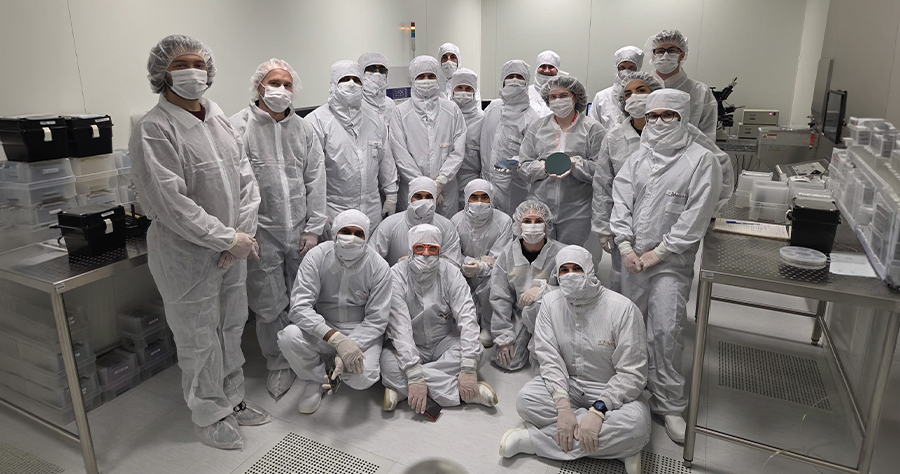
The team at Graphene Flagship spin-off, CamGraPhIC.
Credit: CamGraPhIC
Author bio

Graphene Flagship
Bringing together 126 academic and industrial partners in 13 research and innovation projects and 1 coordination and support project, the Graphene Flagship initiative will continue to advance Europe’s strategic autonomy in technologies that rely on graphene and other 2D materials. The initiative, which builds on the previous 10-years of the Graphene Flagship, is funded by the European Commission’s Horizon Europe research and innovation programme.