


Spotlight: 2DSPIN-TECH's Harvey Stanfield
Meet Harvey Stanfield, a PhD student in experimental condensed matter physics at the University of Manchester a partner in the Graphene Flagship's 2DSPIN-TECH project.
Harvey Stanfield is focusing on the fabrication and electrical characterisation of structures containing novel, 2D magnetic materials. He knows that the materials are full of surprises and even found out that they kind of rhyme!
What specific 2D materials are you working on within 2DSPIN-TECH?
Within the 2DSPIN-TECH, I work with two variations of the common 2D magnet Fe3GeTe2: Fe3GaTe2 (which we call FGaT) and Fe2.5Co2.5GeTe2 (CFGT). Whilst both are room temperature 2D magnets, FGaT is a rather simple ferromagnet, whereas CFGT is proving to be quite a bit more complex, demonstrating both ferro- and antiferromagnetic phases, says Harvey Stanfield.
Have you discovered any novel properties of the materials that you didn’t expect?
The materials I predominantly work with are both full of surprises, but one that was quite interesting is observing exchange bias in individual flakes of either material FGaT and CFGT. Exchange bias, a phenomenon typically observed in bilayers, is an interaction between anti- and ferromagnetic phases. In CFGT, it originates from its own two distinct phases, whereas FGaT, during its fabrication process, can oxidate, and that oxide is antiferromagnetic. I found it fascinating that the systems are so similar yet different, as if they rhyme.
How do you envisage the role of 2D ferromagnetic materials in future spintronic devices?
2D ferromagnets are interesting in their own right; what really sets them apart is the role they play in heterostructures. Chiefly, we’ve seen the rise in Magnetic Random Access Memory (MRAM) in industry, and how utilising 2D materials in these structures can unlock greater energy efficiency and scalability than traditional amorphous ferromagnets. As 2D materials, the interactions at the interface they can induce when combined with other materials are still a hot topic, says Harvey Stanfield.
✅ Read about young researcher Tarik Hossain here.
✅ Read about young researcher Kovács-Krausz Zoltán here.
✅ Read about young researcher Roselle Ngaloy here.
✅ Read more about 2DSPIN-TECH here.
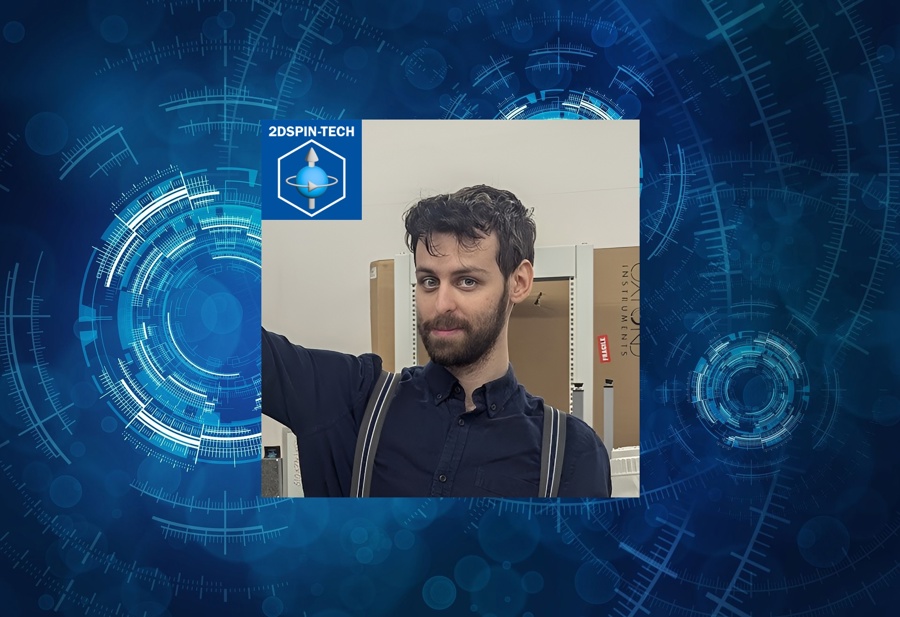
Harvey Stanfield is a PhD student in experimental condensed matter physics at the University of Manchester a partner in the Graphene Flagship's 2DSPIN-TECH project.
The materials I predominantly work with are both full of surprises, but one that was quite interesting is observing exchange bias in individual flakes of either material FGaT and CFGT."
PhD student, University of Manchester
Author bio

2DSPIN-TECH
2DSPIN-TECH is a Horizon Europe research and innovation project within the Graphene Flagship. 2DSPIN-TECH has the ambition to significantly reduce energy consumption, promote sustainability, and improve the overall performance of computer memory. The 2D topological spin-orbit materials can generate a giant current-induced spin polarization, whereas room temperature 2D magnets provide the prospective of electric control of magnetism. 2DSPIN-TECH is coordinated by Prof. Saroj Dash at Chalmers University of Technology.