
Energy Generation
Next gen solar cells
The Energy Generation Work Package addresses different approaches for energy harvesting: harnessing the energy of the sun with large-area photovoltaics and producing hydrogen with water electrolysers.
The last 10 years
This ten-year journey allowed us to bridge the gap between laboratory prototypes and up-scaled demonstrations, targeting applications in large-area solar panels for on-grid electricity generation, and flexible solar modules to power Internet of Things (IoT) devices. We developed various graphene and related materials (GRMs) and integrated them with perovskite solar cells to enhance both stability and efficiency. Technical issues that had slowed down the photovoltaics upscaling process have been resolved, including the replacement of noble metals, the processing of titanium dioxide at low temperatures and the optimisation of laser patterning. Moreover, GRM-based conductive pastes and novel encapsulants led to stable and efficient modules with low capital expenditure (CAPEX).
On the fuel cell front, we developed graphene-enabled supports for electrocatalysis. Initially, they were meant to promote only the oxygen reduction reaction, but at a later stage, electrocatalysts featuring a graphene-based support were also developed to promote the hydrogen evolution reaction and the oxygen evolution reaction at low-temperatures. We also devised graphene-based anticorrosion coatings, as well as easily scalable solid-state and liquid-based approaches to obtain enough inexpensive graphene. The resulting demonstrators showed an outstanding performance and durability in the electrochemical processes.
This year’s progress
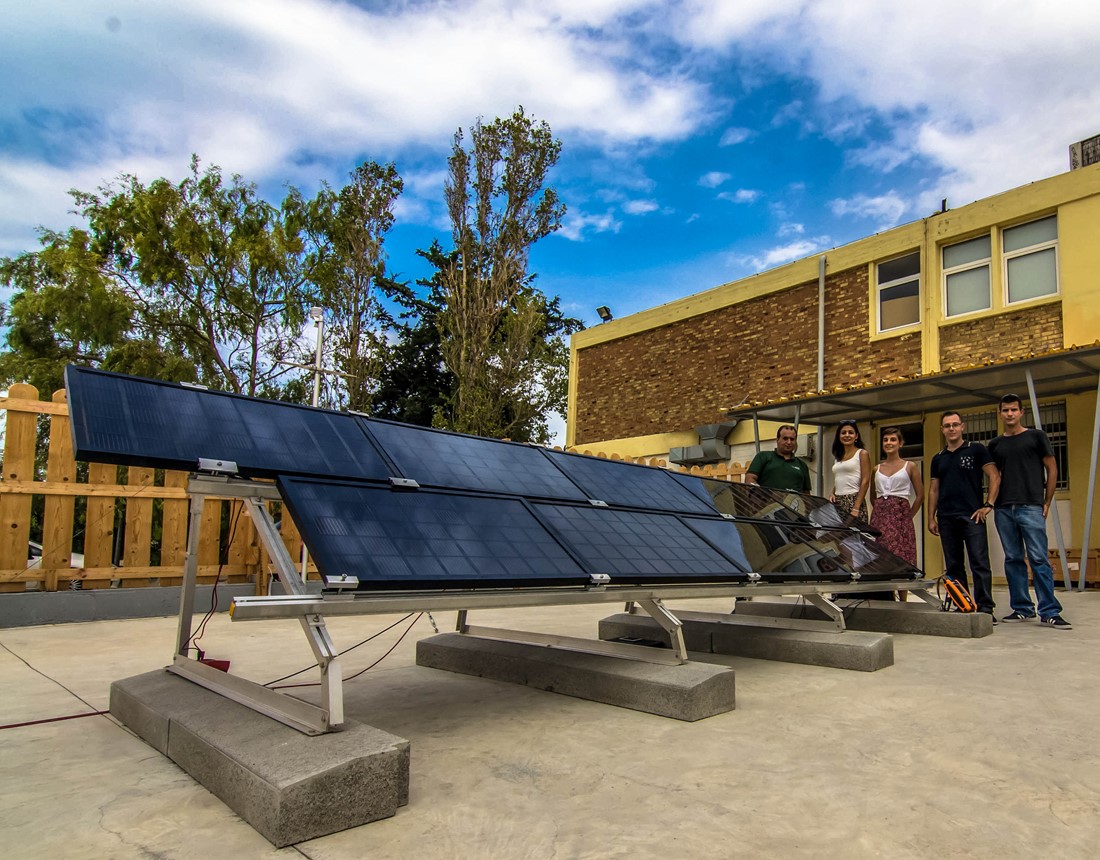
The Energy Generation Work Package’s effort led to the world’s first outdoor demonstration of a solar farm with 4.5 m2 graphene–perovskite panels. These delivered a peak power exceeding 250 W and demonstrated a remarkable stability: only a 20% reduction in the performance over eight months. Gathered in an open data repository, all experimental data will be of interest to the photovoltaics industrial sector and will lay the groundwork for commercialisation targets. We reached high technology readiness levels (TRLs); TRL 6 in the solar farm demonstration, TRL 4-5 in the transparent conductive electrodes based on exfoliated graphene hybrids, and TRL 5 in the fully printed, flexible perovskite solar modules with stabilised output power for indoor applications. Finally, a life cycle assessment (LCA) model indicated that this technology might compete with those calculated for European 2050 electricity mix scenarios.
We devised graphene-enabled electrocatalysts that promote key processes for the operation of fuel cells and electrolysers, exhibiting a performance and durability beyond the state-of-the-art. These are also free from or with minimal concentrations of strategic elements, such as platinum group metals.
The GRM-enabled functional components, mostly supports and electrocatalysts, have already been synthesised in batches of 5-100 grams and could easily be scaled up. Such functional components are already available on the market for demo purposes and sampling by one of our industrial partners, BRETON.

Emmanuel Kymakis, Work Package Leader
A new generation of scientists was trained, becoming proficient in a hot field with profound implications for the future of mankind.”
Work Package Leader
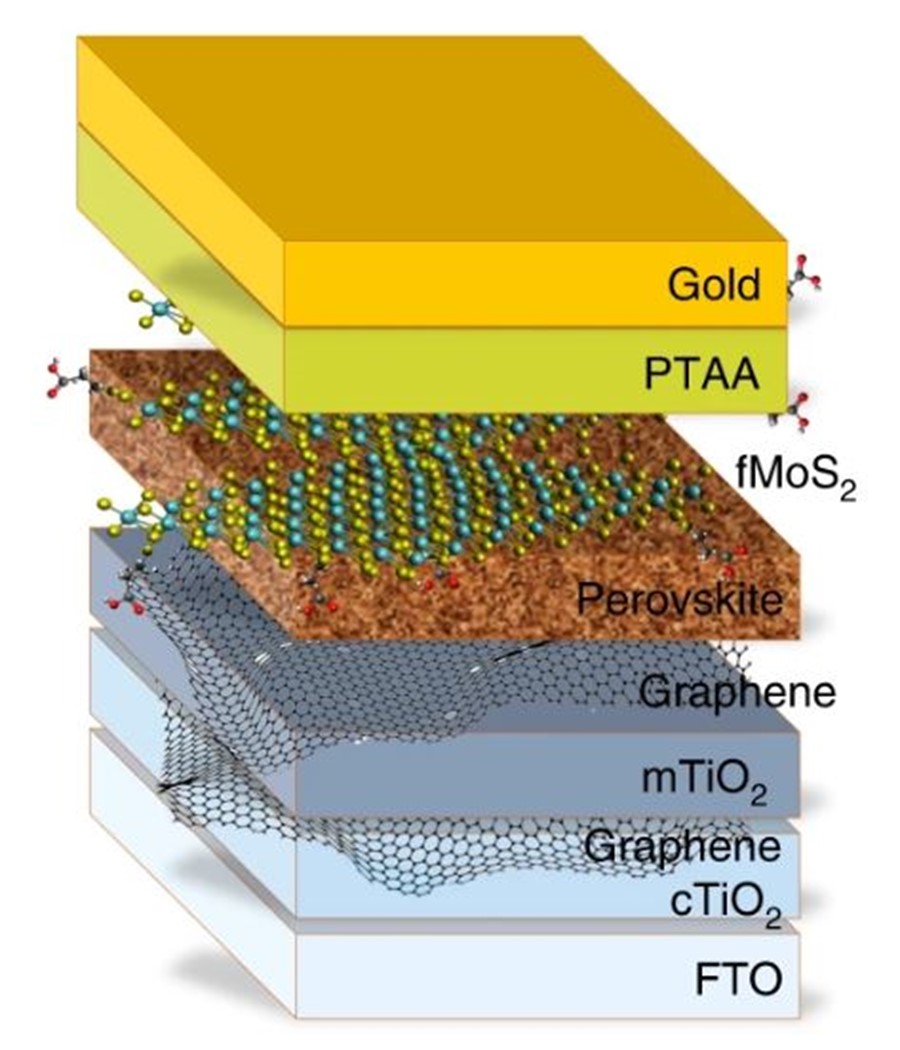
The solar panel consists of several layers: glass with fluorine-doped tin oxide (FTO), compact titanium dioxide (TiO2) with graphene, mesoporous TiO2 with graphene, perovskite, fMoS2, poly(triarylamine) and gold. In the scale-up and sustainable mass production of this technology, gold can be replaced with an alternative material, such as graphene, other carbon materials or cheap metals. Credit: Nature Energy
References
Pescetelli, S. et al. Nature Energy 2022, DOI: 10.1038/s41560-022-01035-4
Zhang, H. et al. Nature Commun. 2022, DOI: 10.1038/s41467-021-27740-4
Castriotta, L. A. et al. Adv. Energy Mater. 2022, DOI: 10.1002/aenm.202103420
Di Noto, V. et al. ACS Catal. 2022, DOI: 10.1021/acscatal.2c03723
Lorandi, F. et al. Power Sources 2023, DOI: 10.1016/j.jpowsour.2022.232390
Latest Articles

Going green with graphene

Graphene Week 2026 brings the global 2D materials community to Porto for the first time
The world’s graphene and 2D materials community will gather in Porto, Portugal, from 21–25 September for Graphene Week 2026, the 21st edition of Europe’s leading conference dedicated to graphene and related two-dimensional materials. For the first time in its history, Graphene Week will take place in Portugal, bringing more than 400 researchers, industry leaders, entrepreneurs and students together with Portugal’s growing advanced materials ecosystem.

From Smart Textiles to Space Energy Storage: GRAPHERGIA at Graphene Week 2026
GRAPHERGIA is delighted to announce participation in Graphene Week 2026, marking it their third consecutive year. This year's programme will include a workshop co-organised with the ARMS project, an oral presentation, three poster presentations, and an exhibition featuring two of the project’s key demonstrators.

Spotlight: Sina Dörr
Sina Dörr, a PhD student at the University of Kassel, won the Impact Leader Award at Graphene Week 2025 in Vicenza, Italy. She now shares with us her thoughts on 2D materials and explains her research using transition metal dichalcogenides to improve raindrop triboelectric nanogenerators.

Graphene oxide added to the composition of the liquid artificial retina: A further step toward clinical trials
Graphene Flagship partner, the Istituto Italiano di Tecnologia, together with IRCCS Azienda Ospedaliera Metropolitana – Policlinico San Martino Hospital, has demonstrated that graphene oxide—used for the first time in the ophthalmic field—enhances the liquid artificial retina, increasing light sensitivity and recovery of visual function in advanced stages of retinitis pigmentosa. The study, published in Nature Communications, led to the restoration of electrical activity in the visual cortex, bringing this strategy closer to future clinical trials in humans.

GRAPHERGIA invites you to take part in Social Life Cycle Assessment survey
Have you ever considered the importance of social factors in shaping innovation outcomes?
